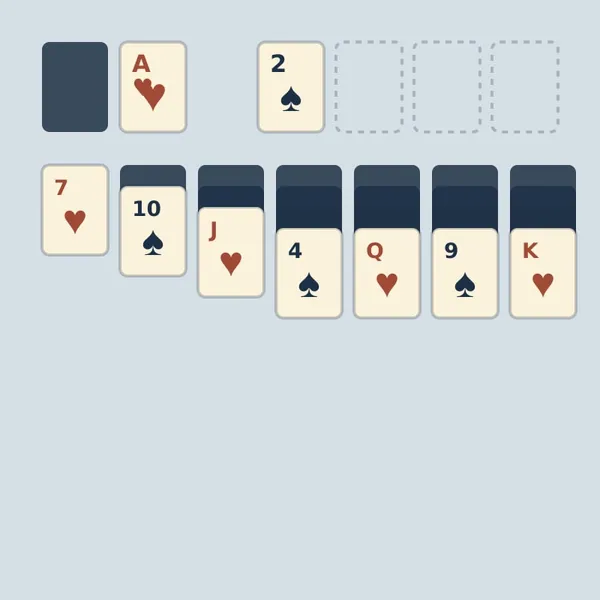
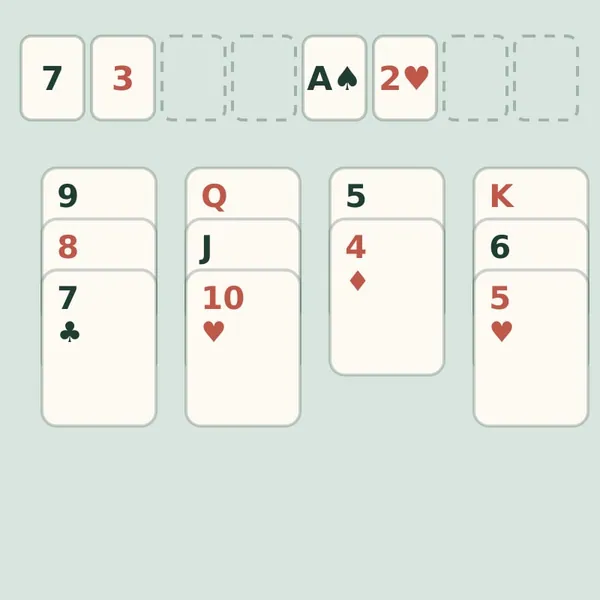
Spider Solitaire is a two-deck patience game, and it plays very differently from the one-deck kind. You can drop a card on any card one rank higher, whatever its suit. But you can only pick up runs that share a suit. That gap between what you can build and what you can move is the whole game. Mixed-suit stacks are easy to make and hard to undo.
The real resource is space. An empty column lets you take apart a stack, sort it and rebuild it. Most wins come from making empty columns and using them well.
Early priorities
The deal puts 54 cards in ten columns. The four left-hand columns hold six cards each and the other six hold five. Only the bottom card of each is face-up.
- Uncover hidden cards first. Each card you turn over gives you more options. Columns with the most hidden cards are worth the most attention.
- Aim at one column to empty. Pick the shortest, easiest column and work toward clearing it. One empty column changes everything.
- Build in suit when you have a choice. If a 7 of spades and a 7 of hearts could both go on an 8 of spades, use the spade. A same-suit run can still move later. A mixed one is stuck until you break it apart.
- Make off-suit moves only when they gain something. Placing a heart on a spade is fine if it turns over a card or empties a column. Doing it just to tidy up blocks you later.
Using empty columns well
An empty column accepts any card or run. Treat it as a workspace, not a parking spot.
- Don't fill it with a king too soon. A king in a column can only leave to another empty column. Put one there only when the king starts a run you mean to finish.
- Sort mixed stacks through it. Move the bottom same-suit run into the empty column. Then move the next run where it belongs, and bring the first one back. Two empty columns let you unpick far longer stacks.
- Fill every column before dealing. You can't deal from the stock while any column is empty. Put something in it, ideally a card that can easily move again.
A worked example in two suits
Say one column ends in 9 of spades, 8 of hearts, 7 of hearts. Another column ends in a 9 of hearts. You'd like the hearts to sit on the heart 9. The 8 and 7 of hearts are a same-suit run, so you can move them together onto the 9 of hearts. Now the 9 of spades is free at the bottom of its column. If a 10 of spades is open elsewhere, move the 9 there and the column shrinks again. Now you have a heart run of three and a spade run growing on its own. That's the pattern to look for. Find the place where a mixed stack splits by suit, and move each part to its own suit.
When to deal, and what goes wrong
You get five deals from the stock, and each puts a card on every column. Deal when you've run out of useful moves, not before. First make the moves that turn over cards, since the new row will bury them again.
Common mistakes:
- Dealing too early. Every deal adds a card to every column, often on top of runs you were building.
- Building long mixed stacks. They look like progress but can't move as a whole.
- Using an empty column for one small move. Plan two or three moves ahead of filling it.
Learning by suit count
The suit count is the difficulty. With one suit every card is a spade, so every build is in suit and you can focus on empty columns and timing your deals. Two suits brings in the main skill, choosing the in-suit move and splitting mixed stacks. Four suits needs all of it, and empty columns become precious. The score starts at 500, loses a point per move and gains 100 for each finished run, so efficient play shows up there. Move up a level once you win most games on the one before.