Doubling, one block at a time
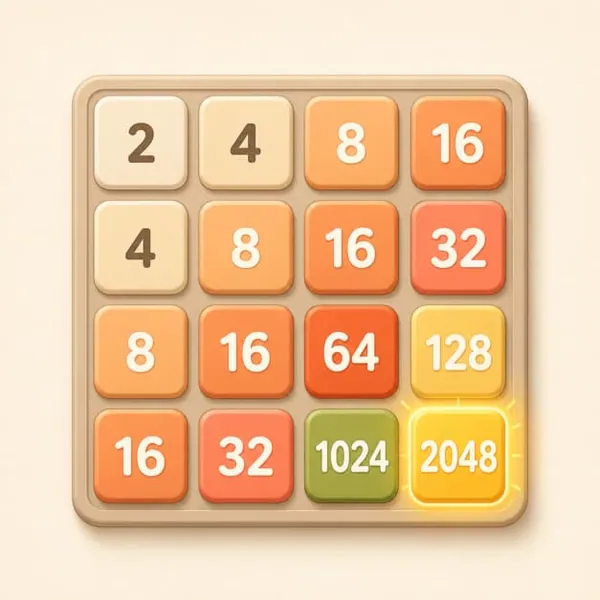
2048 Shooter keeps the doubling rule of 2048 but changes how blocks move. You don't slide the board. You fire one block into one of five columns, and it hangs under whatever is already there. Each column holds seven blocks. Nothing ever leaves the board except by merging, so every shot either builds toward something or takes up space for good.
That makes the game feel closer to stacking than sliding. The blocks at the top of each column are the oldest and the hardest to change. The lowest block in each column is the only one you can reach directly. Think of the bottom edge of the board as your working surface.
Build columns that fall like dominoes
The strongest shape is a column that gets smaller as it goes down. Picture a column reading 64, 32, 16, 8 from top to bottom. Shoot an 8 into it. The new 8 lands under the old 8 and they merge into a 16. A match above takes the merged block, so the 16 sits where the old 8 was, right under the 16. Those merge into a 32, then into a 64, then into a 128 at the top. One shot sets off four merges, and you score every number made: 16, 32, 64 and 128.
To set this up:
- Shoot big draws into big columns. A 32 belongs under a 64, not under a 4.
- Keep one column for small numbers. When a 2 or 4 has nowhere useful to go, put it where it can pair up with the next small draw instead of burying a big block.
- Use the side neighbours. A block also merges with a matching block beside it in the next column. A 4 that lands under a 4 with a 4 on each side makes a 32 in one go, because four matching blocks make eight times the number.
- Read the next block. It sits beside the launcher. Swap is free and unlimited, so plan both shots together, and swap whenever the next block fits the board better.
Know what the launcher will hand you
The draw never looks at your board, but it does follow your progress. A run starts with 2s, 4s and 8s, and the smallest numbers come up most often. Bigger numbers join as your best block grows. A 16 can't be drawn until you've made a 256, for example. The range shifts upward too, and the top draw stops at 256.
That has a sharp consequence. Once you've made a 2048, 2s stop coming. Once you've made a 4096, so do 4s. Any 2 still on the board after that can never be matched by a draw. It sits there for the rest of the run, taking up a cell. So clean up your small blocks before you make your next big milestone. A board with stray 2s and 4s stuck high in the columns is the most common way a long run suddenly ends.
Mistakes that fill the columns
- Burying a big block. Shooting a small number under a 128 seals the 128 in until that small block grows all the way back up. Check what's at the bottom of a column before you shoot.
- Spreading evenly. Filling all five columns to the same height feels tidy but leaves no room for awkward draws. Keep at least one column short.
- Forgetting full columns still accept matches. A column with seven blocks takes one more shot if its lowest block has the same number. A full column can be a merge, not a dead end.
- Ignoring the swap hint. When the launcher's block fits nowhere but the next one does, the status line under the board says so. A run ends only when neither block fits.
Getting better
Watch where your chains stop. If a chain breaks because one block in the column is out of order, that's the shot to fix next time. Try to keep every column sorted from big at the top to small at the bottom, and count how many merges your best single shot set off. On a keyboard, keys 1 to 5 fire straight into a column and S swaps, which speeds up your planning once you know the board. Your best score stays in this browser, but a run in progress doesn't, so a refresh starts over.