Reading pictures as words
Puzzles that spell words with pictures are old. Picture riddles, where a drawing of a bee and a leaf might stand for "belief", have been a parlour game for centuries. Emoji Quiz uses the same idea with the small pictures on your phone. Each puzzle is a short row of emoji that points to a word or phrase, such as a film, a song, a book, a saying, a food, an animal, a place or an activity.
There are three ways an emoji can point to its answer, and good solvers try all three.
- Literally. A lion and a crown mean a lion and a king.
- By sound. A picture can stand for a word that sounds like it, the way a bee might stand for "be".
- By association. A snowflake might mean cold, winter or frozen, depending on what else is in the row.
Let the slots do the work
The letter grid is your strongest clue, and it is easy to overlook. The slots show how many words the answer has and how long each word is. A pattern of three, then four, then four letters reads very differently from a single ten-letter word.
A few patterns are worth learning.
- A three-letter first word is often THE.
- Two-letter and three-letter words in the middle are often small joining words: OF, IN, ON, IS, TO, AND.
- Answers use letters only. Punctuation is dropped, so a phrase with an apostrophe in it has no slot for the apostrophe.
Here is a worked example. Say you see a clock followed by a bag of money, over slots of four, two and five letters. The clock gives TIME. The two-letter slot is probably a joining word, and the five-letter slot matches MONEY. That gives TIME IS MONEY. The emoji only drew the two nouns. The grid told you the shape of the saying around them.
Before typing, check the Category label above the board. Knowing you are looking for a song rather than a food removes most wrong readings at once.
Checking and correcting
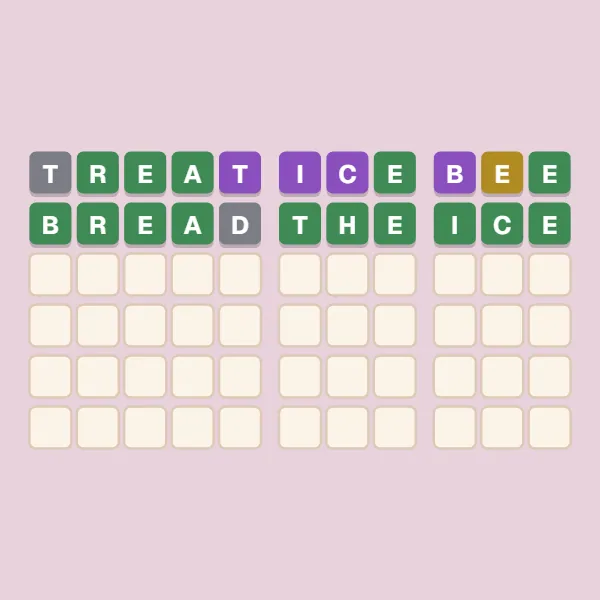
You can check an answer whenever every slot is filled. Letters in the right place turn green and lock, and the rest stay open for you to change. There is no limit on how many times you check.
That makes a near guess useful. If you are fairly sure of the first word but not the second, fill in your best attempt for both and press Enter. The locked greens show which parts were right. Use the Clear key to wipe the unlocked letters and try again around them.
Common mistakes:
- Reading every emoji literally. If a literal reading gives nonsense, try the sound of the picture instead.
- Treating each emoji as one word. Two pictures can combine into a single word, and one picture can stand for a whole idea. Let the slot lengths tell you which is happening.
- Fighting the slot lengths. If your idea does not fit the grid, it is the wrong idea, however good it feels.
Hints and practice
The Reveal letter button fills in one letter that is not yet locked, in every slot where it appears, and shows a short written clue. The counter above the board shows how many you have used and how many remain. A good habit is to try one more reading of the emoji before you reach for a hint, and to use the written clue to steer your thinking rather than to finish the puzzle for you.
From the menu, you can start a random puzzle or choose a category. Choosing a category is a good way to practise. Films and songs reward pop-culture memory. Phrases reward knowing idioms and reading pictures by sound. Places, food and animals are usually more literal and make a gentle start. Once you can solve a category without hints, move to random puzzles, where you have to work out what kind of answer you are looking for as well as the answer itself.