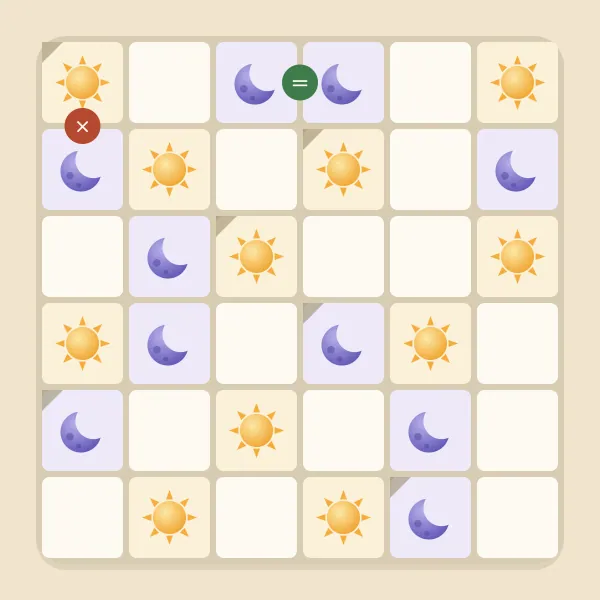
One line, every square
Number Path asks for what mathematicians call a Hamiltonian path. That is a route that visits every square of the grid exactly once. The numbers add a second rule: the route must pass them in order. Finding such a path on a large empty grid is hard. The numbers are what make it a fair puzzle. Each board here has exactly one solution, so every turn of the line can be worked out.
The useful way to think about it is not "how do I get from 2 to 3". It is "which squares can still be reached, and in what order". A short, direct route between two numbers is often wrong. It leaves squares behind that the line can never come back for.
Squares with few ways in
Every square the line passes through, apart from the start and the end, uses exactly two of its neighbours. One is the way in and one is the way out. So look for squares that have only two open neighbours left. The line must pass through both of them, which fixes two steps at once.
- Corners have only two neighbours from the start. Unless a corner holds 1 or the last number, the line enters through one and leaves through the other.
- Edge squares have three neighbours. Once the line has used one of them, the square often has only two choices left.
- Squares beside your line lose a neighbour every time the line passes. Watch the squares you have just walked past, not only the ones ahead.
Here is a short example on the 6×6 board. Say 1 sits right next to the top-left corner, and the corner holds no number. The corner needs two neighbours on the line. One of them is 1. But 1 is the start, so it only has a way out. That means the line must go from 1 straight into the corner, then out the corner's other side. Your first two steps are forced before you have thought about 2 at all.
Don't strand a square
After every few steps, scan for trouble. A square with only one open neighbour left is a dead end. The line can enter it but never leave, so it has to be the very last square, the one with the highest number. If it isn't, back up. The same goes for a pocket of squares your line has walled off. If the pocket doesn't hold the numbers still to come, those squares can no longer be reached.
A neat check comes from colouring the grid like a checkerboard in your head. Each step moves the line to the other colour. So if two numbers sit on the same colour, the line between them takes an even number of steps. If they sit on different colours, it takes an odd number. When a route you are planning has the wrong parity, it must detour somewhere.
Habits that cost time
- Racing to the next number. The quickest route between two numbers rarely covers the squares the line needs. Sweep along walls and fill corners as you pass them.
- Leaving one-square gaps along the edge. A gap one square wide between your line and the wall almost always becomes a dead end.
- Rewinding too little. If you find a stranded square, the mistake is usually several steps back. Drag back further than feels needed, or tap Reset and replan.
- Taking Hint too early. Hint draws the next correct square. If your line has gone wrong, it first rewinds to where it left the solution. That is useful when you are lost, but it also hides which choice was the mistake.
Climbing the levels
Easy is 5×5, Medium is 6×6, Hard is 7×7 and Expert is 8×8. Bigger boards get more numbers, usually around 8, 10, 15 and 20. But there are also more open squares between numbers, so the corner and dead-end checks matter more. Stay on a level until you can finish without Hint, then move up. On a keyboard, the arrow keys draw the line, which can make tight corners easier to steer. Color Links works on the same skill of covering every square, with several lines at once.