A deduction game in five letters
Guessing a hidden word from letter-by-letter feedback is an old pencil-and-paper idea. Word Guess keeps it simple: one five-letter word, six tries, and three colours. Underneath, it is a game about information. Each guess is a question you ask the board, and the best questions are the ones whose answers cut the list of possible words the most.
That changes how you should think about your first two or three rows. Early on, you are not trying to win. You are trying to learn as much as possible, so that the last guesses are easy.
Building a strong opening
A good first word uses five different letters, and most of them common ones. Letters like E, A, R, O, T, L, I, S and N turn up in a large share of five-letter words. A word such as STARE tests five of them in one go.
Your second word matters as much as your first. If the first row comes back mostly grey, play a word with five fresh letters rather than shuffling the ones you already tried. STARE followed by CLOUD covers ten different letters in two rows. Add PINKY and you have tested fifteen, including the vowels I and Y.
Here is how the reasoning goes in practice. Say STARE comes back with A green in the middle and R yellow in the fourth slot. Now you know the word looks like two letters, then A, then two letters. R is in it, but not fourth, and it cannot be third because A is there. S, T and E are out. That still leaves BRAND, GRAND, CRANK, DRAIN, PRAWN, CRAMP and FRAUD, among others. Guessing them one at a time could burn every row you have left. A word like PUNCH, which tests P, N, C and U together, splits that list sharply. After it, you are usually down to one or two candidates.
Reading the colours carefully
Most mistakes in Word Guess come from misreading what the colours promise.
- Repeated letters. The board marks greens first, then gives out yellows from left to right. If you guess a word with two Es and the answer has one, only one E gets a colour and the other turns grey. That grey does not mean E is absent. It means there is no second E.
- Yellow carries two facts. The letter is in the word, and it is not in that slot. Players often remember the first fact and forget the second, then waste a guess placing the letter in the same spot again.
- The keyboard is a summary. Each key shows the best colour that letter has earned so far. Check it before every guess, so you never play a letter you already ruled out.
Traps worth knowing
Some word shapes have many endings. If you have IGHT locked in, the first letter could be F, L, M, N, R, S or T. Guessing them in order is a coin flip that can run out of rows. A better move is a word that tests several of those letters at once. FIRST, for instance, checks F, R, S and T in a single guess.
Do not assume the answer has five different letters. Words with a doubled letter are common, and when your candidates run dry, a repeat is often the missing piece.
Practising with harder settings
There is no difficulty picker here. Instead, the settings panel has two switches. High Contrast Colors changes the palette for easier reading. Hard Mode forces you to use what you learn: any green letter must stay in its slot, and any yellow letter must appear in your next guess, away from the slot where it showed yellow.
A sensible path is to play normally until you can solve most words in four guesses. Then switch on Hard Mode. It removes the probe words that test fresh letters, so it trains you to pick each guess more carefully. The statistics panel keeps your record, which helps you see whether a habit is really helping.
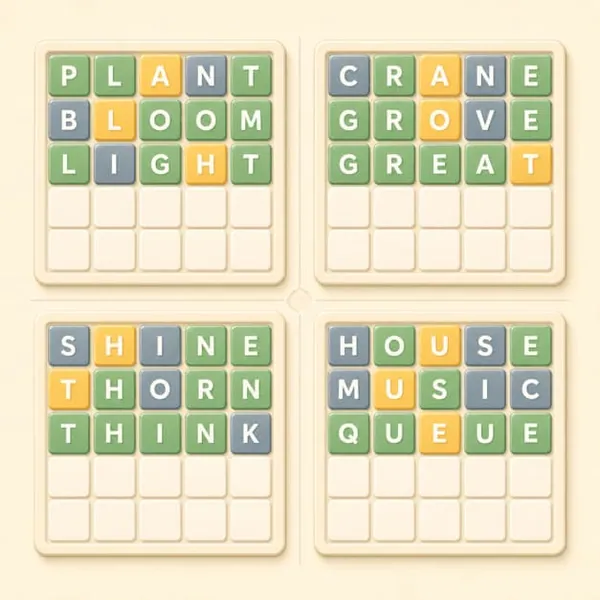
The Challenge button lets you pick any valid five-letter word and send a friend a link to it. Choosing tricky words for others, with repeated letters or crowded endings, is a good way to learn which patterns are hard. If you want more boards at once, Quad Words uses the same feedback across four words.