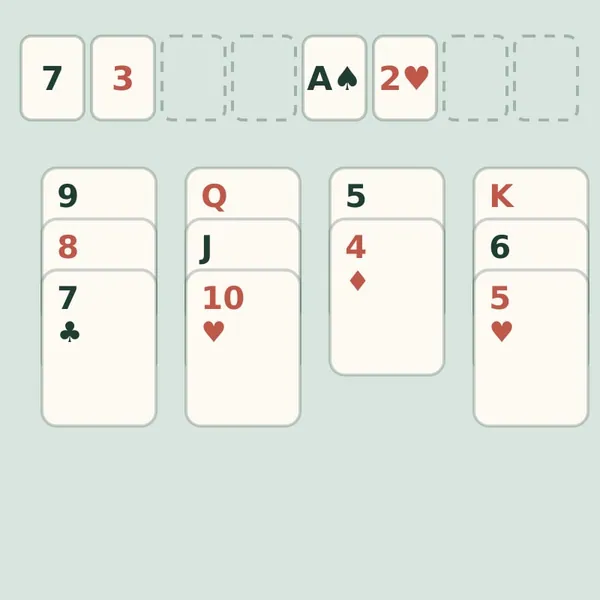
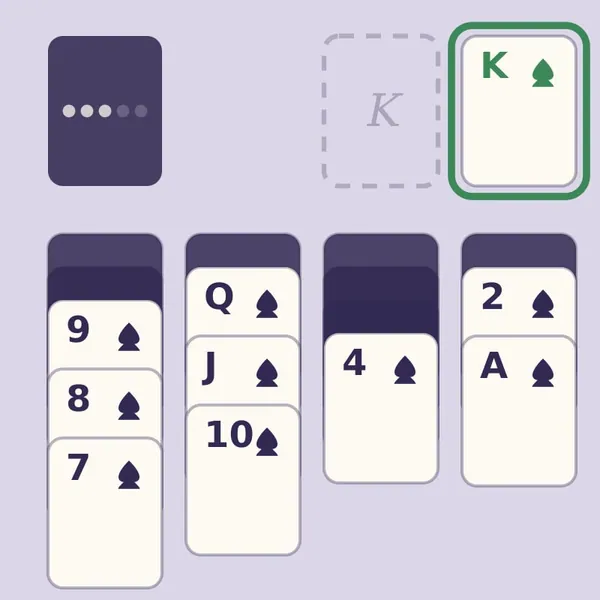
The Solitaire on this site is Klondike, the patience game most people learned first. It's part luck and part planning. Some deals can't be won however well you play, especially when drawing three cards at a time. Many more are lost to small, avoidable choices. The face-down cards are the whole problem. Every decision should help you turn them over.
What to do first
When a new deal appears, look before you click. Check the seven face-up cards for any aces or twos, then for any moves between columns. Then make your moves in roughly this order.
- Play aces and twos to the foundations. They never help in the tableau.
- Make moves that turn over a face-down card. A move that only shifts a face-up card from one column to another gains nothing unless it opens something up.
- Prefer the tallest columns. The tallest column starts with six hidden cards. Freeing it early gives you more of the deck to work with than clearing a short column.
- Draw from the stock last. The stock is always there. The tableau moves often are not, once the next card turns over.
Choices that look equal but aren't
Klondike often offers two moves that seem the same. Picking the right one is most of the skill.
- Two cards could go on the same spot. Say a black 8 is open and both red 7s are free. Move the one sitting on face-down cards, so a new card turns over. Leave the other where it is.
- Emptying a column. An empty column only accepts a king. Don't empty one unless a king, or a king with a run on it, is ready to fill it.
- Which king to place. If two kings could fill an empty column, choose the one whose move frees more hidden cards.
- Moving cards up too early. A 5 of hearts on the foundation can't hold a black 4 for you anymore. Move higher cards up when both colours of the next lower rank are already there, or when you no longer need them to build. You can also take a card back down from a foundation to the tableau when that helps.
A worked example with Draw 3
In Draw 3, only the top card of each three-card turn is playable. Say you go through the stock and the 7 of spades you need is the middle card of a turn. You can't reach it this pass. But if you play the top card of an earlier turn first, every turn after it shifts by one card. Then the 7 may come up on top next time. So when you see a useful card buried in the waste, playing even one card from the waste can change what you reach on the next pass. You can cycle the stock as many times as you like, so this costs only moves.
Common mistakes
- Building long runs on the shortest columns. They tie up cards without freeing anything.
- Drawing out of habit. Look at the whole tableau before every draw.
- Giving up a deal too early. Undo has no limit. When you're stuck, step back a few moves and try another order.
Getting better over time
Start with Draw 1. Every card in the stock is reachable on each pass, so you can focus on tableau choices. Once you win most Draw 1 games, switch to Draw 3, the classic rule. It teaches you to track which cards are coming and to plan around the waste. Switching between them shuffles a new deal.
Use undo to learn, not just to recover. After a loss, rewind to a choice where two moves looked equal, take the other one, and see how far it goes. When every card is face-up and the stock and waste are empty, the Auto button finishes the game for you. If you want a version with no hidden cards at all, FreeCell is pure planning from the first move.